






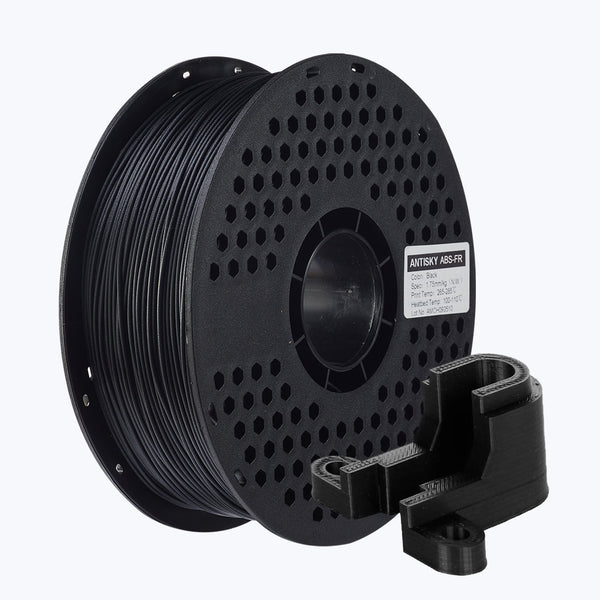
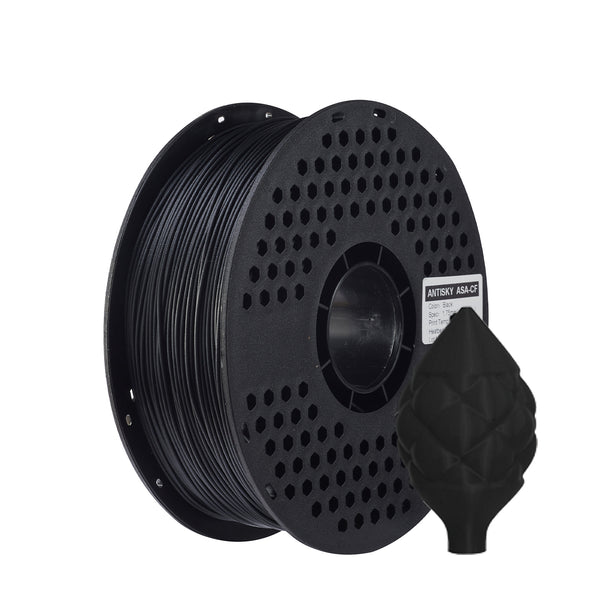
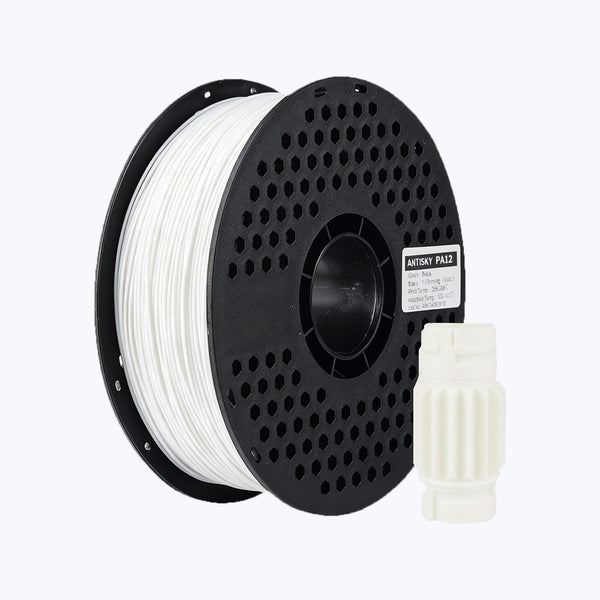
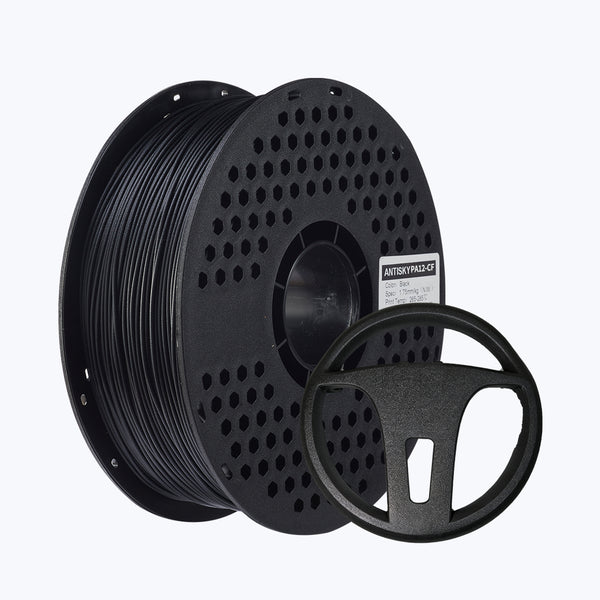













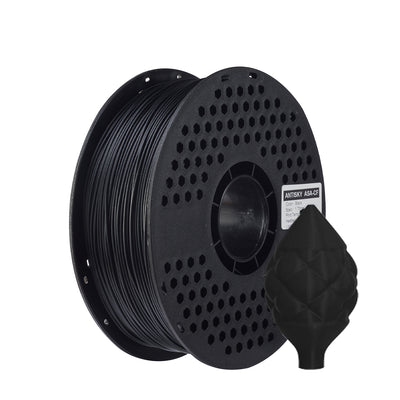
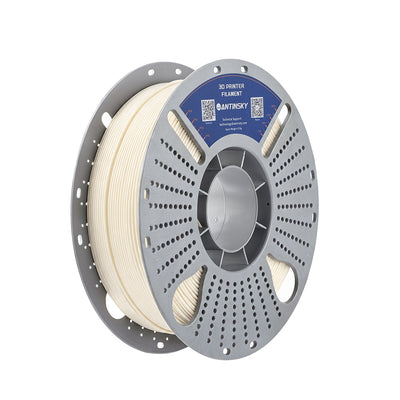
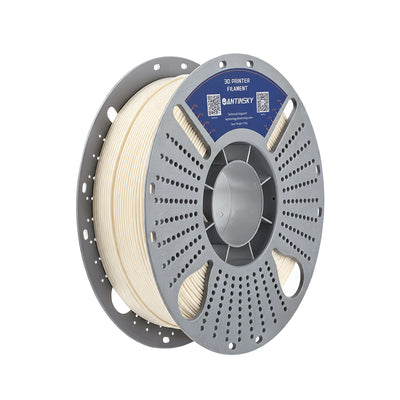
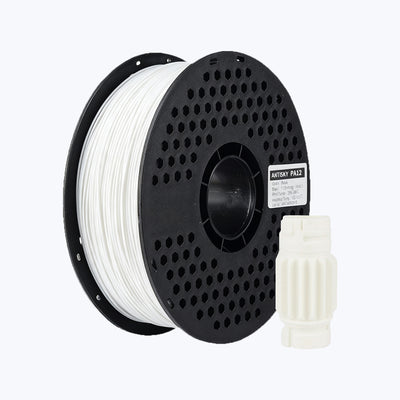
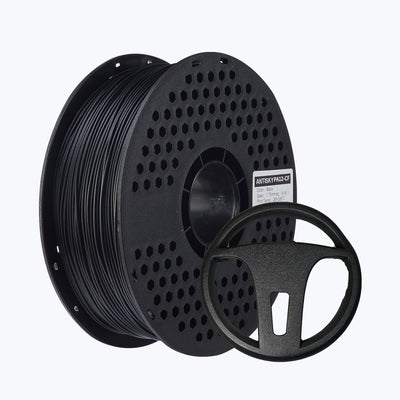




Once you move past PLA and PETG, the questions stop being about color and start being about service temperature, stiffness, chemical exposure, and whether the part will creep under load. Carbon-filled engineering filaments are the answer to those questions — but PPA-CF, PPS-CF, PPS-GF and PA12-CF are not interchangeable. This guide explains what each one is actually for, what it costs you in process complexity, and when the cheaper option is the correct engineering choice.
Why Carbon Filling Changes Everything
Adding 20–30% chopped carbon fiber to a polymer does three things:
- Raises stiffness dramatically. Modulus can double or triple compared to the unfilled polymer. A bracket that flexed now does not.
- Reduces thermal expansion. Less movement under heat means better dimensional stability in precision parts.
- Increases heat deflection temperature. The part holds shape under load at temperatures where the base polymer would sag.
It also does three things you have to plan for:
- Abrasive wear. Chopped fiber destroys brass nozzles. Hardened steel or tungsten carbide is mandatory.
- Reduced elongation. Stiffer almost always means more brittle. Carbon-filled parts snap instead of bending, and layer adhesion becomes the weak link.
- Anisotropy. Parts are strong along the extrusion path and weak across layers. Orientation is now an engineering decision, not an aesthetic one.
The Four Contenders at a Glance
| Material | Polymer base | Strength profile | Heat resistance | Difficulty |
|---|---|---|---|---|
| PA12-CF | Polyamide 12 | Strong, tough-ish, good fatigue life | Moderate | Medium |
| PPA-CF30 HT | Polyphthalamide | Very stiff, high strength retention when hot | High | High |
| PPS-CF | Polyphenylene sulfide | Very stiff, chemically inert, brittle | Very high | Very high |
| PPS-GF | PPS + glass fiber | Stiff, dimensionally stable, less abrasive than CF | Very high | Very high |
Read that table as a ladder, not a ranking. Each step up buys heat and chemical resistance with printability, cost, and brittleness. Most people who buy PPS-CF for a bracket that lives at 60 °C have bought the wrong material.
PA12-CF: The Practical Entry Point
PA12-CF is where most functional printing should start. Polyamide 12 absorbs far less moisture than PA6 or PA6/66, which makes it dramatically easier to print well: less popping, less stringing, and a much wider window between "dry enough" and "wet."
What it gives you:
- High strength and good fatigue resistance — repeated load cycles do not crack it quickly.
- Moderate heat resistance, adequate for brackets, housings, jigs, and most machinery guards.
- Impact behavior that is forgiving compared to PPS, which matters if the part gets dropped.
- Good chemical resistance to oils, greases, and fuels.
What it does not give you:
- Continuous service much above 100–120 °C under load.
- Dimensional stability in a hot, humid environment — it still absorbs some moisture and grows slightly.
- UV stability. Unpainted PA parts degrade outdoors.
| Parameter | PA12-CF starting point |
|---|---|
| Nozzle | 270–290 °C, hardened |
| Bed | 80–100 °C |
| Chamber | 45–60 °C strongly preferred |
| Part cooling | 0–20% |
| Speed | 30–60 mm/s |
| Drying | 70–80 °C for 8–12 h before printing |
PPA-CF30 HT: The Hot-Engine Bay Material
Polyphthalamide sits in the same family as nylon but with an aromatic backbone that raises the glass transition and improves strength retention at temperature. In practice, PPA-CF is the choice when a part must stay stiff and strong at 120–150 °C, not merely survive it.
Where PPA-CF is genuinely the right answer:
- Under-hood brackets, intake components, and mounts near heat sources.
- Structural parts that see both load and elevated temperature simultaneously — this is the case where PA12-CF sags and PPA does not.
- Parts that need low moisture absorption plus high stiffness. PPA absorbs less water than PA6/66 and holds dimensions better.
- Electrical and connector housings, where PPA's dielectric behavior and heat resistance are well established in injection molding.
Where it is overkill:
- Room-temperature brackets — PA12-CF is cheaper, tougher, and easier.
- Anything needing high elongation or impact absorption.
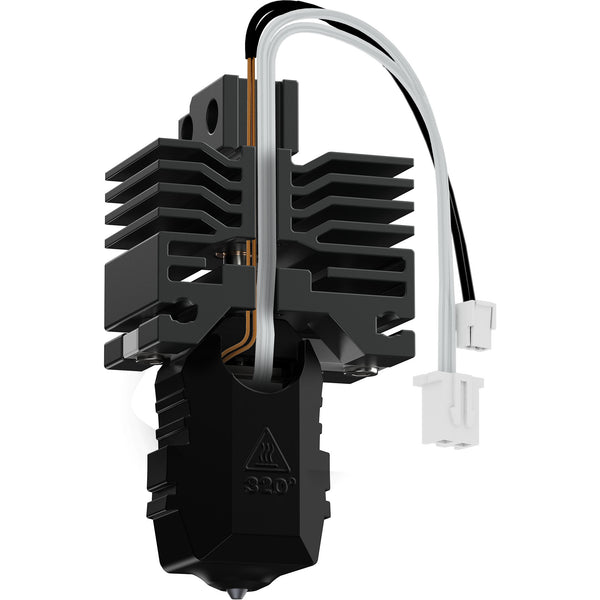
PPA-CF is demanding to print. It wants a hot chamber, a hardened hotend capable of sustained 300 °C+, and aggressive drying. It is also notably more expensive per kilo, and the 500 g spool format reflects how much most shops actually use.
PPS-CF and PPS-GF: The Chemical and Heat Extremes
Polyphenylene sulfide is a semi-crystalline engineering polymer with a combination that is hard to beat: continuous service around 200 °C, near-total resistance to solvents, fuels, acids, and bases, inherently low flammability, and very low moisture absorption.
That combination is why PPS is used in chemical processing, aerospace ducting, and automotive fuel systems. It is also why PPS-CF is one of the hardest filaments to print successfully.
What PPS buys you
- Chemical inertness. Nothing at room temperature dissolves it. Solvent exposure that would destroy PA or PETG is irrelevant.
- Heat resistance. It holds properties far beyond where PPA starts to soften.
- Dimensional stability. Very low moisture uptake means the part you print is the part you get, months later.
- Flame behavior. Inherently flame retardant without additives.
What PPS costs you
- Brittleness. PPS-CF snaps. Thin walls and sharp internal corners are crack initiation sites. Design with radii.
- Process difficulty. Nozzle temperatures in the 310–340 °C range, bed near 120 °C, and a hot chamber. Not every printer can do this, and the ones that can are not cheap.
- Annealing. Many PPS parts need a controlled post-print anneal to reach published properties. Skip it and you get a part that looks right and performs at half spec.
- Cost. The most expensive material in this comparison, by a wide margin.
PPS-CF vs PPS-GF
Same polymer, different reinforcement. Carbon fiber gives higher stiffness and lower weight; glass fiber gives better impact behavior, better electrical insulation, and slightly less nozzle wear. If the part is structural, choose CF. If it is an insulator or takes impacts, choose GF. If it is a housing that must not conduct, GF is the correct call regardless of stiffness numbers.
Choosing by Application
| Application | Best choice | Why |
|---|---|---|
| Robot end-effector brackets | PA12-CF | Stiff, tough, fatigue resistant, affordable |
| Under-hood mount, 130 °C continuous | PPA-CF30 HT | Strength retention at temperature |
| Fuel line clip, solvent exposure | PPS-CF | Chemical inertness is non-negotiable here |
| Electrical insulator, hot environment | PPS-GF | Non-conductive reinforcement |
| Drone frame component | PA12-CF or PPA-CF | Stiffness-to-weight, impact tolerance |
| Pump housing, chemical duty | PPS-CF | Solvent and acid resistance |
| General workshop jig | PA12-CF | Cheapest material that will not fail |
| Hot air duct, 180 °C | PPS-CF | Only material here with margin at that temperature |
The Process Requirements Nobody Warns You About
Drying is not optional
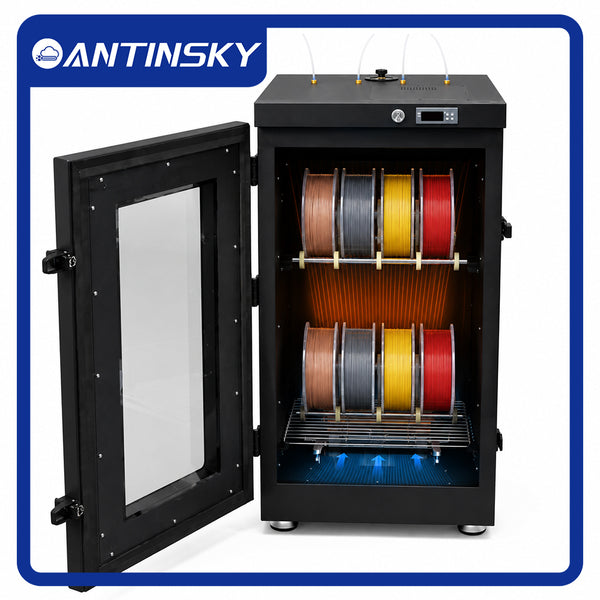
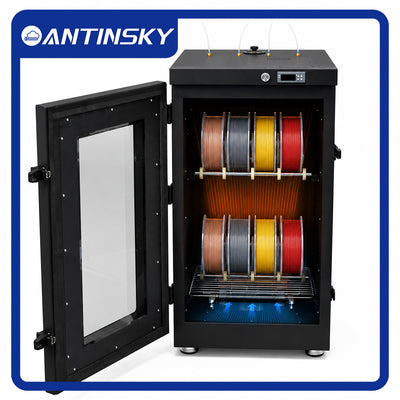
PA12 absorbs less moisture than PA6, but it still absorbs. PPA and PPS absorb far less, but the fiber sizing and the spool environment still matter. The rule: dry every engineering filament before every print, at 80 °C for 8+ hours for polyamides, and store it in a dry box while printing. Wet polyamide prints look acceptable and perform at a fraction of spec — you will not see the problem until the part fails.
Hardened nozzle, always
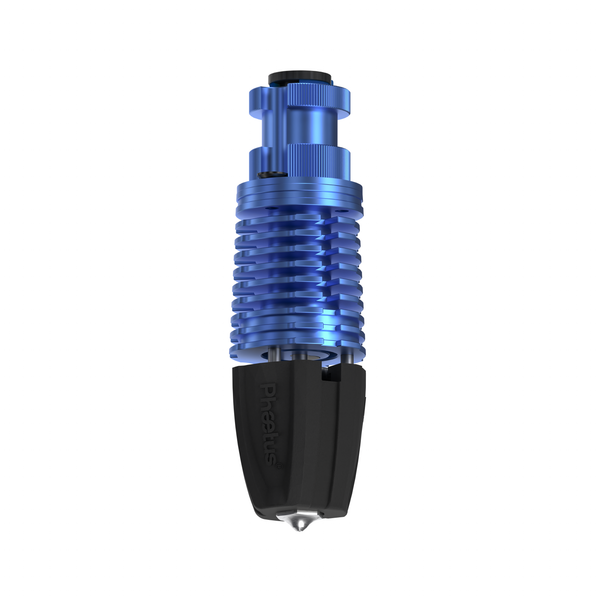
Chopped fiber is abrasive. A brass nozzle will open up within a few hundred grams, extrusion width will drift, and you will chase a "settings problem" that is actually a worn nozzle. Use hardened steel or tungsten carbide. A tungsten nozzle costs more than brass and lasts many times longer — over the life of a spool it is the cheaper option.
The chamber matters more than the hotend
Engineering polymers shrink as they cool. An open printer produces parts with warped corners and delaminated layers no matter what the nozzle temperature says. A chamber at 50–60 °C for PA12-CF and 80–100 °C for PPS changes the outcome more than any slicer setting.
Annealing
Many PPS and PPA parts reach published properties only after a controlled anneal — typically a slow ramp, a hold near the material's recommended temperature, and a slow cool. Faster cooling locks in stress and produces parts that crack later, sometimes weeks later, with no load applied.
Design for anisotropy
Layer adhesion is the weak axis. If a bracket will be pulled apart, orient it so the load runs along the extrusion path. If that is impossible, add ribs, increase wall count, or switch to a tougher material. Geometry beats material selection more often than people expect.
Cost Reality
| Material | Typical spool | Relative cost | When the cost is justified |
|---|---|---|---|
| PA12-CF | 1 kg | Mid | Almost always — best value in the group |
| PPA-CF30 HT | 500 g | High | Heat plus load, simultaneously |
| PPS-CF | 500 g | Very high | Chemical exposure or >150 °C service |
| PPS-GF | 1 kg | High | Electrical insulation at temperature |
The failure mode here is buying PPS-CF for a part that only needed to be stiff at room temperature. You pay five times more, fight the process for a week, and get a part that is more brittle than the PA12-CF version. Start at the bottom of the ladder and climb only when a real requirement forces it.
There is also a hidden cost in time. A PPS print with a proper drying cycle, a hot chamber soak, and a controlled anneal can occupy a machine for most of a day for a part that PA12-CF would have produced before lunch. If your machine hours are the constraint rather than material cost, that trade matters more than the price per kilo.
When metal is the right answer
No filament replaces machined aluminum for a part that must hold tolerance under vibration, or stainless for anything structural near a heat source. The honest boundary: printed engineering parts win on geometry freedom, lead time, and weight. They lose on absolute strength, fatigue life, and creep. If a part has already failed twice in CF filament, the third attempt should probably be metal.
Frequently Asked Questions
Can I print PPA-CF or PPS-CF on a normal printer?
Usually no. These materials need nozzle temperatures above 300 °C, a bed near 120 °C, a heated chamber, and an all-metal hotend with a hardened nozzle. A stock printer without those capabilities will produce delaminated, warped parts regardless of slicer settings.
Is carbon fiber filament actually stronger?
It is stiffer, which is often what people mean. Tensile strength may increase modestly, but elongation drops and layer adhesion does not improve. A CF part can be more brittle than the unfilled version. Choose CF for stiffness and dimensional stability, not for toughness.
Do I need to anneal PA12-CF?
Not always, but it improves dimensional stability and relieves internal stress. For precision parts or parts that see heat, anneal. For general brackets, a hot chamber print is often sufficient.
Why do my PPS parts crack after a few weeks?
Usually residual stress from fast cooling or no anneal, combined with sharp internal corners. Ramp the cool-down, anneal per the datasheet, and add radii to internal geometry. PPS is brittle — it will not forgive stress concentrators.
What is the difference between PA12-CF and PA6-CF?
PA12 absorbs much less moisture, prints with less warping, and is easier to dial in. PA6-CF is stronger and stiffer but far more moisture-sensitive and harder to print reliably. For most users PA12-CF is the better trade.
Can these materials be used outdoors?
PPS is excellent outdoors — UV, moisture, and temperature are all handled. PPA is good but benefits from paint or coating. PA12-CF degrades under sustained UV and should be painted if it lives outside.
How do I store engineering filament?
Sealed with desiccant, ideally in a dry box that feeds the printer. Polyamides should go back into dry storage the moment a print finishes. A spool left out overnight in a humid room can print noticeably worse the next morning.
Is glass fiber safer than carbon fiber for nozzles?
Both are abrasive. Glass is generally slightly less aggressive but still requires a hardened nozzle. Neither is safe for brass over long runs.
The Bottom Line
Start with PA12-CF. It is the material that solves the largest number of real problems at the lowest process cost. Move to PPA-CF30 HT when the part must carry load at 130 °C, and to PPS-CF only when chemical exposure or sustained 180 °C+ service rules everything else out. If the part is an electrical insulator in a hot environment, PPS-GF is the answer instead.
Whatever you choose, budget for the supporting cast: a hardened nozzle, a dryer, and a chamber. Those three items decide whether the spool performs to spec or becomes an expensive lesson. If you want the unfilled baseline for comparison, our nylon vs PETG vs ABS guide covers where standard engineering filaments stop being enough.